
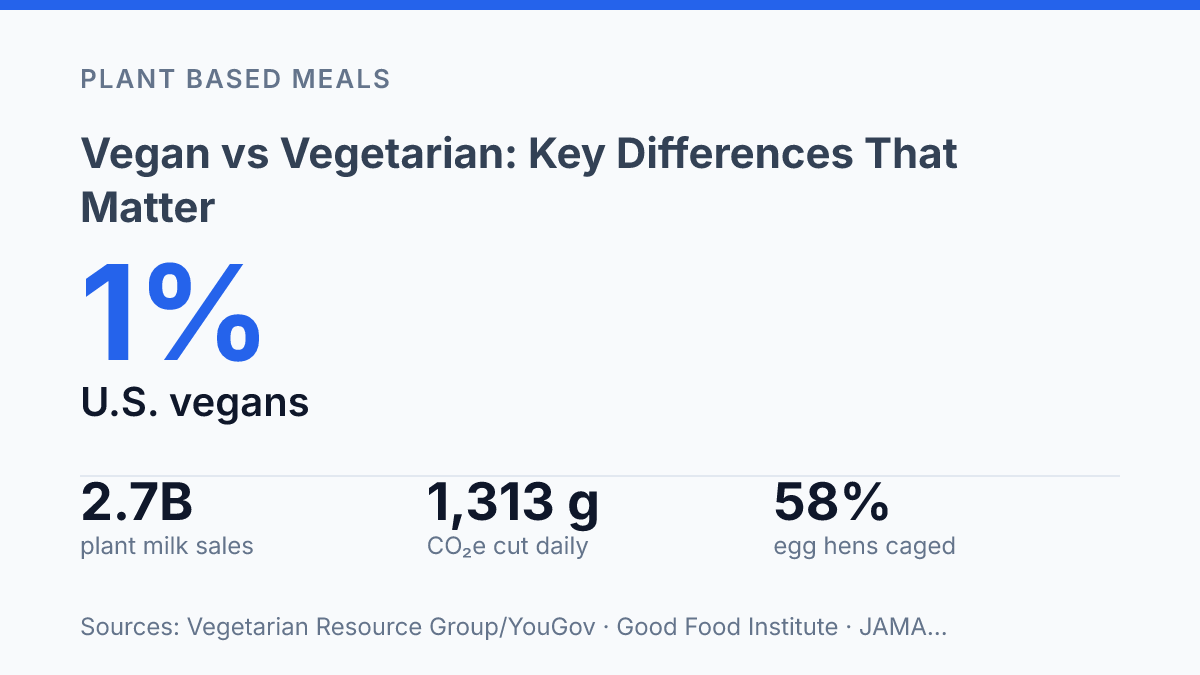
The vegan vs vegetarian split looks tiny on paper: in a 2025 U.S. poll by Vegetarian Resource Group/YouGov, only 1% of adults were vegan, yet nearly one in three said they eat vegan meals at least sometimes.
That gap matters. Labels sound fixed, but real eating habits are messier. Someone may skip meat, buy oat milk, order vegan lunches, then still keep eggs in the fridge.
The key difference isn’t just one food group. It changes how you shop, how closely you plan nutrients like B12, and where you draw the ethical line on dairy and eggs. In my honest opinion, the dairy-and-egg question is where the comparison gets serious, not where it gets technical.
This guide cuts through the label confusion and shows what changes in daily life when you choose one path over the other.
What each diet allows on the plate
The label meat-free can still hide milk proteins, egg solids, gelatin, or chicken broth. That’s the first real split in vegan vs vegetarian eating: one avoids animal flesh, the other avoids animal-derived foods more broadly.
In the standard vegetarian pattern, meat, poultry, and fish stay off the plate. Dairy and eggs, though, are commonly still in the picture. A cheese omelet, yogurt parfait, or pasta with Parmesan can fit that pattern even though each contains animal products.
A vegan plate draws the line further out. It excludes meat, dairy, eggs, honey, and other ingredients that come from animals. That means no butter in the mashed potatoes, no egg in the breading, and no honey in the granola bar.
A 2025 poll from Vegetarian Resource Group/YouGov used a weighted sample of 2,199 U.S. adults, fielded June 27–July 1, 2025, and drew the same line: vegetarian meant never consuming meat, fish, seafood, or poultry, while vegan also excluded dairy and eggs. That definition matters. Surveys, menus, and package labels don’t always use these words with the same care.
Packaged foods create the most confusion. Gelatin can come from animal collagen. whey and casein come from milk. Animal broth can sit inside soups, sauces, rice mixes, and frozen meals that look harmless at first glance.
So the stricter-looking word isn’t always the one doing the most work. Meat-free tells you what’s missing. It doesn’t tell you what’s still inside. In my view, the label check matters more than the headline claim, especially when dairy, eggs, and hidden animal ingredients can turn a vegetarian item into a non-vegan one fast.
How the two diets differ in daily practice
The milk aisle now makes the switch easier than the cheese case does. U.S. plant-based milk reached $2.7 billion in retail sales and 13% of total milk dollar sales in 2025, according to the Good Food Institute. That shows why cow’s milk vs oat milk is now a routine decision, not a specialty-store errand.
Cheese is trickier. A vegetarian shopper can buy cheddar, mozzarella, or parmesan without changing much else. A stricter plant-only shopper has to test plant-based cheese for melt, salt, texture, and price.
Some are excellent. Some still taste like compromise.
Eggs create the biggest day-to-day fork in the road. Vegetarians can lean on eggs for breakfast, baking, quick dinners, and extra protein. Without them, tofu scrambles, flax “eggs,” chia gels, and commercial egg replacers do the work.
They’re useful. They ask you to learn a new rhythm.
Vegetarian eating can look easier at first, but vegan shopping is often cleaner once you learn the label patterns… and that’s the part people miss. Dairy and egg callouts are usually clear in allergen statements. The tradeoff is upfront effort: you spend more time learning brands, then less time making exceptions.
Restaurant ordering exposes the gap fast. Bread may be brushed with butter. Tomato sauce may arrive with parmesan already stirred in.
Thai curry, stir-fries, and dipping sauces may contain fish sauce even when the dish looks plant-based. You’ll often get a better answer by asking, “Can this be made without butter, dairy, egg, or fish sauce?” than by asking whether something is “meat-free.”
Protein planning also changes shape. Vegetarians can build meals around yogurt and eggs, then add beans, lentils, tofu, or tempeh as needed. Fully plant-based meals rely more consistently on beans, lentils, tofu, tempeh, soy milk, nuts, seeds, and grains. In my honest opinion, the practical win goes to the person who plans two dependable protein anchors per meal, not the person with the purest label.
Health, ethics, and environment: where the gap widens
The ethical gap gets sharpest at breakfast: a meatless omelet can still depend on caged hens. As of September 2024, the Animal Welfare Institute estimated that 58% of more than 307 million U.S. egg-laying hens were still kept in battery cages. That detail matters.
Vegetarian eating can reduce animal harm. It doesn’t fully reject animal use.
Vegan ethics draw a harder line. They treat milk, eggs, wool, leather, and similar goods as part of the same system of exploitation, not harmless by-products.
Dairy is the uncomfortable middle ground. A vegetarian pattern can lean heavily on cheese, yogurt, butter, and eggs, especially when meat is removed but habits stay familiar. In my humble opinion, that’s where the animal-welfare case becomes weaker than many people expect.
The environmental gap also widens when dairy and eggs leave the plate. A 2025 JAMA Network Open analysis found that a low-fat vegan diet cut greenhouse gas emissions by 1,313 grams of CO2-equivalent per person per day over 16 weeks. The biggest drop came from less meat, but cutting dairy added more savings.
Land use tells the same story, with a sharper edge. Poore and Nemecek’s 2018 Science analysis found that animal-derived foods supply 18% of global calories but use 83% of farmland. So the more a diet shifts toward plants, the less pressure it puts on grazing land and feed-crop acreage.
Health is less tidy. Removing dairy and eggs can lower saturated fat for some people. It also removes easy sources of B12, calcium, iodine, and certain omega-3 fats.
That doesn’t make the stricter pattern unhealthy. It makes planning non-negotiable.
The B12 gap shows up clearly in intake data. A 2024 NDNS analysis of UK women of childbearing age reported median B12 intake at 0.9 mcg for vegans and 1.7 mcg for vegetarians. Supplement use was higher among vegans too, at 50% versus 27%, according to Niklewicz and colleagues.
Calcium and iodine need the same level of attention once dairy is gone. Fortified plant milks, calcium-set tofu, iodized salt, seaweed used carefully, and algae-based DHA or EPA can close the gap. But you have to choose them on purpose… assumptions don’t nourish anyone.
Which approach fits your goals?
Only 1% of U.S. adults identified as vegan in 2025 national polling, but 30% said they ate fully plant-based meals at least sometimes. That gap says a lot.
The real choice isn’t a badge. It’s the set of rules you can keep on a dull Tuesday.
Vegetarian eating may fit first if you’re easing off meat, cooking for a mixed household, or not ready to give up dairy and eggs. It also gives you more room at family meals and casual restaurants. That flexibility matters when your goal is momentum, not purity.
Vegan eating may fit first if animal welfare is your main driver or you want stricter control over ingredients. A clear line can reduce negotiation.
If it comes from an animal, you skip it. For some people, that rule feels simpler than weighing every exception.
Use a three-part decision frame. Ask which approach gives you enough flexibility to eat well, enough social ease to avoid constant friction, and enough consistency to last beyond the first month.
If restaurants shape your week, tools such as HappyCow can make stricter choices less stressful. If home cooking drives your routine, your pantry matters more than any app.
Here’s the tension: the stricter diet is not always the easier one to keep. The looser one can blur into habits you were trying to leave behind. In my view, that’s the part people underplay when they choose based on identity alone.
A vegetarian plan can drift toward cheese-heavy convenience. A vegan plan can fail if it demands a full lifestyle overhaul overnight.
Match the diet to your pressure points. If you need social flexibility, start with the wider lane and set firm personal rules. If you need clean boundaries, choose the stricter lane and plan your defaults before hunger makes the decision for you.
The choice that has to work on a regular Tuesday
The next move is less about picking the perfect label and more about choosing the friction you can live with.
Plant-based milk is already normal shopping behavior. The Good Food Institute reported $2.7 billion in U.S. plant-based milk sales in 2025, but plant-based meat still sits in a much smaller corner of the meat aisle. That contrast tells you something useful.
Some swaps are easy. Others ask more from your habits, budget, and patience.
If you’re choosing between vegan and vegetarian, test the hardest part first. Try the breakfast, the restaurant order, the family meal, the vitamin routine. In my humble opinion, a diet that survives an ordinary Tuesday matters more than one that looks perfect on paper.
Frequently Asked Questions
Q: What is the main difference between vegan and vegetarian?
A: The core difference is simple: vegetarians don’t eat meat. They often still eat dairy and eggs. Vegans avoid all animal products completely, including milk, cheese, eggs, and honey in many cases. That gap matters more than people expect, especially when you’re checking menus or labels.
Q: Can a vegetarian eat eggs and dairy?
A: Yes, many vegetarians do. Most vegetarian diets allow dairy and eggs. They still leave out meat. In my view, that’s the cleanest way to tell the two apart without overthinking it.
Q: Do vegans eat cheese or milk?
A: No, vegans don’t eat cheese or milk because those are animal products. That’s the sharp line between the two diets… and it’s the one that trips people up most in restaurants. A vegetarian might say yes to both. A vegan won’t.
Q: Is a vegan diet healthier than a vegetarian diet?
A: Not automatically. Both can be healthy if they’re planned well, but either one can miss key nutrients if you’re careless. The real difference isn’t health by default. It’s what foods you leave out and how well you replace them.
Q: How do I know if a product is vegan or vegetarian?
A: Check the ingredient list first. Vegetarian products can still contain dairy, eggs, or other animal-derived ingredients, while vegan products exclude all animal products completely. Labels help, but they’re not perfect. A quick scan for milk, eggs, gelatin, and honey saves time.